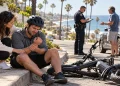
If you were hurt in an e-bike accident in Orange County, get medical care, document the scene, and avoid talking to the insurance company until you know your rights. Fault depends on what happened, not on who was riding the e-bike. Riders hit by cars and pedestrians hit by e-bikes can both have claims. Whether the vehicle was a legal e-bike or an e-moto can change who pays. Most claims must be filed within two years.
You are sitting on the curb on Pacific Coast Highway. Your wrist is throbbing, your back wheel is bent, and the driver who turned in front of you is already telling the officer you “came out of nowhere.” Or maybe you were walking near a school in Irvine when a teenager on an e-bike slammed into you. Either way, you are hurting, and you are wondering what happens next.
If you are searching for an e-bike accident lawyer in Orange County, you are not alone. E-bike injuries have exploded across the county in just a few years. Cities are scrambling to write new rules, and insurance companies are using the confusion to deny or shrink claims.
Take a breath. You have rights, whether you were the rider or the person who got hit. This guide walks you through what to do right now, who may be responsible, and how to keep an insurance adjuster from deciding your case for you.
What to Do Right After an E-Bike Accident in Orange County
Quick take: Get to safety, call 911, and get medical care, even if you feel okay. Then document everything before the scene changes. What you do in the first hour can shape your entire claim.
The moments after a crash are chaotic. Adrenaline can hide serious injuries like concussions, fractures, and internal bleeding. A quick medical visit protects your health and creates a record that links your injuries to the crash.
-
Call 911 and ask for a police report, even for a “minor” crash
-
Photograph everything: the e-bike, the car or rider involved, road conditions, and your injuries
-
Get names and phone numbers of witnesses before they leave
-
Keep the bike as is. Do not repair it or throw it out, since it is evidence
-
Save your helmet, even if it is cracked
-
Do not give a recorded statement to any insurance company yet
E-Bike or E-Moto? Why the Label Changes Your Claim
Quick take: California has three legal classes of e-bikes. A faster, more powerful “e-moto” that does not fit those classes is treated like a motor vehicle. That label can change which insurance applies and how fault is argued.
California law defines legal e-bikes in Vehicle Code section 312.5. Each class has fully working pedals and an electric motor of 750 watts or less. Here is the plain-English version:
-
Class 1: Pedal assist only, stops helping at 20 mph
-
Class 2: Has a throttle, tops out at 20 mph
-
Class 3: Pedal assist up to 28 mph; riders must be at least 16 and wear a helmet
Many of the “e-bikes” kids ride today are actually electric motorcycles. They may have no working pedals, a bigger motor, or a top speed far above 28 mph. Legally, those are motor vehicles. They generally require a license, registration, and insurance.
Why does that matter to you? If an e-moto hit you, its rider may have been breaking the law just by riding it on the street. And if it should have been insured as a motor vehicle and was not, your own uninsured motorist coverage may apply.
What the vehicle really is matters more than what the box called it.
Who Is at Fault in an E-Bike Crash?
Quick take: Whoever was careless is at fault. That could be a driver, the e-bike rider, a city with a dangerous road, or more than one party. California lets you recover even if you are partly at fault, but your share reduces your compensation.
Drivers cause many e-bike crashes, often because they misjudge how fast an e-bike is moving. Common examples include:
-
Left turns across the path of an oncoming e-bike
-
Right hooks, when a driver turns right across a bike lane
-
Dooring, when a parked driver opens a door into a rider
-
Unsafe passing without leaving enough room
California uses a “pure comparative fault” rule. That means if you were 20% at fault, you can still recover 80% of your damages. Insurers know this, and they will look hard for any reason to bump up your share of blame.
When parents can be responsible
If a minor caused the crash, the parents may be responsible in some situations. Under Civil Code section 1714.1, parents can be held liable, up to a capped amount, for a child’s willful misconduct. Parents can also be responsible for their own carelessness, such as buying or modifying an illegal e-moto for a child who could not handle it.
Hit by an E-Bike Rider? You May Still Have a Claim
Quick take: Yes. If an e-bike rider hit you as a pedestrian or another cyclist, you may have a claim against that rider. Depending on the facts, the rider’s parents, or their homeowner’s or renter’s insurance, may also be involved.
Pedestrians are getting hurt more often, especially on boardwalks, sidewalks, and near schools. Because a legal e-bike is not a motor vehicle, the rider usually does not have auto insurance. That surprises many people.
Coverage may come from the sources below. Many homeowner’s and renter’s policies exclude motorized vehicles, so the exact policy language determines whether e-bike crashes are covered.
-
The rider’s homeowner’s or renter’s insurance policy
-
The parents’ policy, if the rider is a minor living at home
-
The rider personally, if they have assets
-
Auto-related coverage, if the “e-bike” was really an e-moto that legally counted as a motor vehicle
Older adults are especially at risk of serious injuries like hip fractures and head trauma. If you or a loved one suffered a head injury, our brain injury attorneys can help you understand the long-term costs.
New 2026 E-Bike Rules and Orange County Crackdowns
Quick take: California now requires e-bikes to show a rear red reflector or light at all hours, and many Orange County cities have added their own rules. These rules can become evidence of fault after a crash.
The numbers explain the crackdown. According to Voice of OC, trauma activations for e-bike injuries at CHOC rose from 38 in 2022 to 201 in 2025. Here is what has changed:
-
Statewide (AB 544): E-bikes must have a rear red reflector or light during all hours, according to the CHP’s 2026 new laws summary
-
District Attorney: The OC DA created a unit focused on illegal e-bike and e-moto use, NBC Los Angeles reported
-
Huntington Beach: Can cite unsafe riders and impound illegal devices
-
Irvine, Garden Grove, and Fullerton: Added stricter riding and parental accountability rules
-
Newport-Mesa Unified: Banned e-bikes for elementary and middle school students starting fall 2026
A 2024 Orange County Grand Jury review found that all 34 cities had different e-bike rules. That patchwork means the rules that apply to your crash depend on exactly where it happened. Local knowledge matters, whether you were hurt in Huntington Beach, Irvine, or Garden Grove.
A broken safety rule is not just a ticket. It can be proof of who caused your crash.
How Insurance Companies Fight E-Bike Accident Claims
Quick take: Insurers look for reasons to blame the rider or pay as little as possible. Expect questions about your speed, your helmet, and your bike. Knowing their playbook helps you avoid falling into it.
Adjusters are trained to protect the insurance company’s money, not your recovery. Watch for these tactics:
-
“You weren’t wearing a helmet.” Not wearing one may affect some arguments, but it does not excuse a driver who hit you
-
“You were going too fast.” They may claim you were speeding, even on a legal Class 1 or 2 bike
-
“Your bike was modified.” They may argue it was an illegal e-moto to shift blame
-
A quick, low offer. An early check often comes before you know the full extent of your injuries
-
A recorded statement. Your own words, taken out of context, can be used to reduce your claim
You are not required to give the other driver’s insurer a recorded statement. It is okay to say you will follow up after speaking with a lawyer.
How Long You Have to File an E-Bike Accident Claim in Orange County
Quick take: In most cases, you have two years from the date of injury to file a lawsuit in California. If a city or county road defect played a role, you may have only six months to file a government claim.
Deadlines are where strong cases quietly die. Here are the key points to consider:
-
Two years for most personal injury lawsuits, under Code of Civil Procedure section 335.1
-
Six months to file a claim against a government agency, such as for a broken bike lane or missing signage, under Government Code section 911.2
-
Minors often get extra time to file a lawsuit, but government claim deadlines can still be short
The sooner you act, the easier it is to save video, find witnesses, and inspect the scene before anything changes.
The Bottom Line
E-bike crashes in Orange County are more common than ever, and the rules are more confusing than ever. That confusion helps insurance companies. Whether you were hit while riding or hit by a rider, your claim depends on the facts, the type of vehicle, and where it happened.
An experienced personal injury lawyer can sort through the city rules, find the right insurance, and push back on unfair blame.
Been in an accident or hurt on the job? You don’t have to navigate insurance companies alone. Oracle Law Firm fights to get you the compensation, control, and clarity you deserve.
Get a Free Consultation or call 888.597.4099.
Disclaimer: This article is for general information only and is not legal advice. Reading it does not create an attorney-client relationship. Every case depends on its own facts, and past results do not guarantee future outcomes. For advice about your situation, speak with a licensed California attorney.
Frequently Asked Questions
What should I do after an e-bike accident in Orange County?
Call 911, get medical care, and document the scene with photos and witness information. Keep the e-bike and helmet as evidence, and avoid giving a recorded statement to an insurance company until you understand your rights. A free consultation with an attorney can help you plan your next steps.
Who pays if a car hits me while I’m on an e-bike?
If the driver caused the crash, their auto insurance is usually the main source of compensation. If the driver lacks insurance or has insufficient coverage, your own uninsured or underinsured motorist coverage may help. California’s comparative fault rule lets you recover even if you share some blame.
Can I file a claim if an e-bike rider hit me as a pedestrian?
Yes. You may have a claim against the rider and, in some cases, the rider’s parents. Because legal e-bikes are not motor vehicles, coverage often comes from a homeowner’s or renter’s insurance policy rather than auto insurance.
What is the difference between an e-bike and an e-moto in California?
Legal e-bikes have working pedals and a motor of 750 watts or less and fall into Class 1, 2, or 3 based on speed and throttle. Vehicles that exceed those limits are generally treated as motor vehicles, which can require a license, registration, and insurance. That difference can affect who is at fault and which insurance applies.
How long do I have to file an e-bike accident claim in California?
Most personal injury lawsuits must be filed within two years of the injury. If a government agency is involved, such as for a dangerous road or bike lane, you may need to file a claim within six months. Speaking with a lawyer early helps protect these deadlines.